
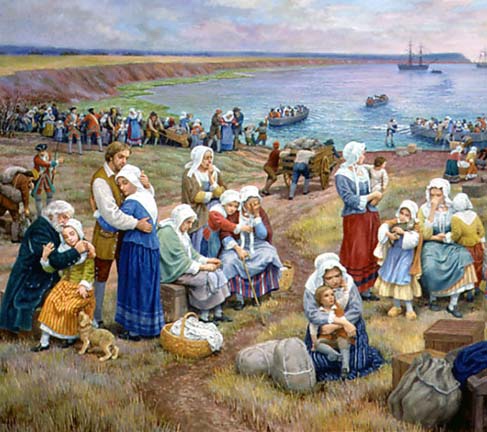
The expulsion of French settlers from the Acadian region of modern day Canada by British officials beginning in 1755 has been studied extensively by historians over the last two hundred years. Historians have been trying to discover what nation was truly responsible for the forced deportation of thousands of civilians. Francis Parkman, a famous 19th century American historian, laid the blame solely on the French royal government that controlled the province, for creating the conditions that necessitated the French settlers’ expulsion by the British. Parkman’s book was published in 1884 and his thesis was considered standard until late in the 20th century when modern historians began to criticize his views. These modern historians have begun not only shifting the blame for the expulsion to the British, but also describing the event as an act of ethnic cleansing.
The Acadians lived in the region south of the Gulf of St. Lawrence, which consists of the modern day Canadian provinces Nova Scotia, Prince Edward Island, New Brunswick, and the north extremities of the U.S. state of Maine. Acadia was part of the larger French Royal colony of New France centered in the St. Lawrence River valley with its capital of Quebec City. The French colonization of Acadia started on May 13, 1606. A vessel by the name of The Jonas embarked from the French port of La Rochelle and carried forty men ashore to form a fishing colony later to be named Port Royal. The settlers encountered native tribes and soon the men began to intermarry amongst them. A mixed population of people was firmly established and provided a link between the two communities. The Acadian people developed a distinct style of farming in which they used series of dikes to drain the salt marshes that lined the coast of the region. By doing this, the French settlers made the land quite fertile and productive.
Since the region boasted excellent fishing grounds, good harbors to export fur, and fertile farm lands, English forces seized Acadia in 1654. They captured the colonial leader who sold them baronial title to legitimize their conquest. The English offered to transport the population back to France, but most chose to stay in Acadia and take an oath of allegiance to the British Crown. The province remained under English control for sixteen years, reverting to French control in 1670. The region was unstable and suffered from a series of British raids and settler reprisals lasting for the next thirty years.
The English authorities were determined to pacify Port Royal and end the French presence that threatened their northern borders. In 1709, a merchant man from New England named Samuel Vetch developed a plan to capture Port Royal and forcibly remove the settlers to the French Island Of Martinique. This plan applied to all of Acadia, but the British authorities decided on a scaled down version in which they would capture Port Royal and disperse the settlements around the fort. The War of Spanish Succession gave the British the chance to carry out their plan and in October of 1710, they captured Port Royal. French soldiers and government officials were transported back to France. Settlers in the district surrounding the fort were given assurances of their safety, but the French communities inland were not under British control. The War of Spanish Succession ended in 1713 and the French were forced to cede Acadia or what is now known as modern day Nova Scotia to the British. The French retained control of the Channel Islands and most importantly, Cape Breton. The Treaty of Utrecht, which ended the war, did not firmly establish a border between the English and French holdings in the region. The French planned a large Fortified Town on Cape Breton called Louisbourg and called for the French settlers under English control to move into French territory. In response to this, the English forced the French inhabitants to sign oaths to the British Crown that required them to serve in the British army. The War of Austrian Succession saw the English capture Louisbourg in 1745, only to cede it back to France in the peace treaty to end the war. Both sides fortified the isthmus that separated Acadia from the mainland of Canada and the English established the Port of Halifax in 1749.
The French and Indian War began in 1754 between England and France as a response to border disputes in the Ohio River Valley. The war would mark the first time that fighting in the colonies spread to Europe. In 1755, the British drove the French from the isthmus separating Acadia from the mainland and sought to pacify the interior of Acadia itself. The British met with representatives of the Acadian communities and demanded that the people sign an unconditional oath of loyalty to the British Crown, which required them to serve in the British army against the French. When they refused to sign, the representatives were arrested and jailed. The British decided to formulate a plan to deport the population of French settlers from Acadia. All adult French males were rounded up from the interior villages and taken to the coast to await deportation. The women and children were forced to follow the men because every village was destroyed and its crops burnt once it was cleared by the British. Perhaps over 7,000 people were deported and dispensed throughout British colonial holdings. When the British captured and destroyed Louisbourg in 1758, more than 5,000 additional people were deported to France, along with the entire French Garrison, who had not received the honors of war after their surrender. Many Acadians ended up in the Spanish colony of Louisiana. Acadians were encouraged by the Spanish government to settle in the region as a barrier against French encroachment. The Acadians were able to melt away in the Bayou and create small self sufficient communities. They adapted their Acadian customs to their new surroundings and created the Cajun culture that still is in existence today.
Francis Parkman was one of the earliest historians to discuss the Acadian expulsion. Montcalm And Wolfe: The French and Indian War was published in 1884 and touches on the issue of the Acadians plight within the sweeping narrative of the French and Indian War. Francis Parkman is one of the most highly regarded nineteenth century American historians. Parkman was born in 1823 to a wealthy family in Boston. He studied at Harvard University and graduated in 1843. He traveled extensively through European capitals as a youth, but he was shaped more by his exploration of almost the entire length of the Oregon trail when he returned from Europe in 1845. He became extremely interested in the history of North America and decided to devote his life to writing on the subject. Francis Parkman died in 1893 and was elected to the Hall of Fame for Great Americans in 1915.
Francis Parkman’s thesis on the reasons behind the Acadian expulsion is “The agents of the French court, civil, military, and ecclesiastical, had made some act of force a necessity.” Francis argues that the French government constantly agitated the populace of Acadia to revolt. Le Loutre, a catholic missionary priest along with his Indians, was acting as an agent of the French King by threatening and cajoling the Acadian people. The French settlers were told “Fidelity to King Louis was inseparable from fidelity to God, and that to swear allegiance to the British Crown was eternal perdition.” The French treated the Acadians as “mere tools of policy. To be used, broken, and flung away.” The French government cheated the Acadians of out of large sums of money through corrupt agents. The Treaty of Utrecht, which he describes as “By the new-fangled construction of the treaty, which the French boundary commissioners had devised, more than half the Acadian peninsula, including nearly all the cultivated land and nearly all the population of French descent, was claimed as belonging to France, though England had held possession of it more than forty years.” Since the treaty claimed France as the rightful owner of much of Acadia, it would be lawful for France to seize it by force. Parkman says the treaty coupled with the fact that “honor demanded of her (France), having incited the Acadians to disaffection, she should intervene to save them from the consequences.” France’s chances of successfully seizing Acadia were good because at anytime more troops could be sent from Louisbourg or Quebec coupled with four thousand militia and Indian fighters. The English, according to Parkman, could not withstand a direct attack because they had little troops and they were scattered far and wide. British officers feared a large French squadron of ships would appear anytime in the Bay of Fundy and this would cause the entire population to revolt against the British. Parkman says the immediate military threat that was caused by the French side had forced the British to make the drastic decision to deport the Acadians. The Acadians were to be given one last chance to declare themselves loyal to the British and not stay in the neutral zone that previous oaths had allowed them to do. The oath that was offered to them required that the Acadians serve in the British army against the French. Deputies representing nine-tenths of the population of Acadia were called before the British governments in Halifax .They were told that the time was short because the French were at hand and could attack any moment. They must either pledge their full loyalty to England or be sent away. They refused the oath and the deportation was then started. He writes “Whatever judgment may be passed on the cruel measure of the wholesale expatriation, it was not put in execution till every resource of patience and persuasion had been tried in vain.” The British were disappointed because they hoped to substitute loyal English subjects in the place of the French. The Massachusetts soldiers that were offered the land choose not to stay in Acadia, but instead went home. This is proof according to Parkman that “this goes far to show that a longing to become their heirs had, as has been alleged, any considerable part in the motives for their removal.” He is referring to the New England soldiers coveting the land of the Acadians and wishing to steal it from them by force. More than six thousand men, women, and children were exiled in 1755. Many Parkman says, remained behind and continued guerilla warfare against the English. The final destination for most was Louisiana were they prospered, while others fled to the Channel Islands and Quebec. Francis Parkman ends his history of the expulsion by saying “The government of Louis XV began with making the Acadians its tools, and ended with making them its victims.”
Nathaniel Hawthorne wrote a book titled, The Whole History of Grandfathers Chair: True Stories from New England History, 1620-1808 in 1840. Though he was a famous author, he is not known as a famous historian. The book is told from the viewpoint of Hawthorne who is represented by a Grandfather lecturing his grandchildren on the history of New England. What the book lacks in scholarly style, it makes up for the shortcoming by giving a culturally accurate opinion on the Acadian expulsion from the New England region in the 19th century. Hawthorne writes, “At the peace of 1748 Acadia had been ceded to England. But the French still claimed a large portion of it, and built forts for its defense. In 1755, these forts were taken, and the whole of Acadia was conquered by three thousand men from Massachusetts, under the command of General Winslow. The inhabitants were accused of supplying the French with provisions, and of doing other things that violated their neutrality. “These accusations were probably true,” observed Grandfather.” He clearly is expressing the same views of the French being at fault, which Parkman later pointed out in his novel. His reference to the Acadians violating their neutrality is referring to the fact that they were violating their oaths to the English, which Parkman also cites as a reason for the expulsion. Hawthorne clearly says the Acadians were not staying neutral and taking sides when he writes “for the Acadians were descended from the French, and had the same friendly feelings towards them that the people of Massachusetts had for the English.” He is expressing the same sense of inevitability that the Acadians would rise up and support the French Military as Parkman would later. Hawthorne ends his account by saying that the English were not harsh in their treatment of the Acadians and that the expulsion was a necessary act of war. He writes, “In the removal of the Acadians, the troops were guilty of no cruelty or outrage, except what was inseparable from the measure.” Hawthorne gives the same account in terms of the number of people removed at around 7,000 Acadians.
While Francis Parkman’s work on the topic had been considered the standard, by the late 20th century historians views had changed dramatically. In Empire of Fortune: Crowns, colonies, and tribes in the Seven years War in America by Francis Jennings, the reasons behind the Acadian expulsion had switched sides with blame falling upon the British. Jennings says that due to “The expanding energies of New England” coupled with Nova Scotia’s Lieutenant governor Charles Lawrence determination to end guerilla warfare through military conquest led to the deportation. Lawrence and his council determined the Acadians had no right to their land until they took a full oath to the British Crown. To make the opinion official, the chief Justice of British Nova Scotia was made to issue a ruling to this affect. Jennings says that the decision to deport the Acadians was made by Governor Lawrence’s council “men who were either New Englanders or who, without exception, had been saturated with that policy (of New England’s expansion) for years.” Lawrence had been given orders by the British Crown to “prevent the Acadians from going over to the French” but no outright explicit order to deport them. Between the council and lieutenant governor, it was decided that the best way to do this was to deport the population. After the expulsion, the council even congratulated Lawrence and promoted him to full governor. Since the Acadians refused to take the oath demanded by the British, they were no longer entitled to their lands. With no lands, they could be deported without a problem. Concerning the deportation, he writes “All in all, some six or seven thousand persons were exiled during the last four months of 1755-one of the largest mass migrations or the era. Other exiles followed.” The British lost many potential workers and at much cost to their treasury. Jennings says, “The British destroyed their homes and all the improvements so laboriously made upon their lands.” The British did indeed settle Acadia with New England settlers in 1760. Unlike Parkman who says the New England men left because they did not want to settle there, Jennings notes that the settlement was delayed by the destruction of the dikes that held back the salt water. The ocean washed over the lands and the British had to eventually summon some of the same Acadians that they had deported, back to fix the problem. The Acadians deportation was paid for mainly through the Acadians own confiscated property and they were not sent to Britain out of fear that much outrage would be expressed by British ministers having to provide funds for their care. The deportees were sent to the thirteen colonies to the amazement of Governors in New York and throughout the south. They were not aware of the deportation or the plans to send the French settlers to their colonies. On the other hand, New England’s colonial governments “had advance notice.”
Frank W. Brecher was a former member of the U.S. Senior Foreign Service and Fellow at Princeton’s University’s Woodrow Wilson School of Public and International Affairs. In Frank Brecher’s Losing A Continent: France’s North American Policy, 1753-1763 written in 1998, builds upon earlier works by expanding the scope of the expulsion. Brecher expands the period of the expulsion from 1755-1758. “The English followed up this 1755 deportation by additional ones of French Acadians from their traditional homelands, and places of wartime refuge, elsewhere in the region: Ile royal, Ile St.Jean, the mainland coastal area along and north of the Bay of Fundy.” Brecher states this second round of deportations occurred in 1758 when the English captured the French fortress town of Louisbourg and this gave them control of the Channel Islands of Cape Breton and St.Jean. More than 5,000 Acadians were deported in 1758 and ironically the most were legitimate French royal subjects living on recognized French land. If one puts this number together with Brecher’s stated number of people deported in 1755 which is around 9,000, then the number of Acadians expelled forcibly from the region stands around 15,000. The author clearly blames English authorities and London itself when he writes “the level of authority behind the action was demonstrated when London itself finally sanctioned this long-standing proposal by Lawrence, and, after English victories later in the war followed up the 1755 deportation by additional ones of French Acadians.” Brecher is stating that London approved of the deportations because it let the second wave of deportations be carried out. Brecher gives the British government in London the benefit of the doubt for the first deportation in 1755, but by their approval of the events in 1758, their guilt is clear. He writes “If one could give the benefit of the doubt to the government of England regarding responsibility for the 1755 deportation, which it had approved only hesitantly and nearly after the fact, this benefit cannot be extended to those of 1758 and later, when the Acadians were forced to leave the region clearly as a result of formal government policy and despite the absence of security concerns.” Brecher says that there was never any serious military threat that could be mounted by France because they could neither muster the naval nor land forces to invade Acadia. Most importantly Brecher refers to the entire event as “the language of the 1990’s, an act of “ethnic cleansing.”
William Nestor’s book The Great Frontier War: Britain, France and the Imperial Struggle for North America, 1607-1755 written in 2000, support Brecher’s claims on the expulsion. Nester is a Professor in the Department of Government and Politics at St.John’s University in New York City. Nestor agrees with Brecher figures and he writes “Between 1755 and 1762, 11,000 to 15,000 Acadians were expelled.” Nestor expands on Brecher’s timeline by extending the period of deportation to 1762. Nestor too clearly blames the British authorities and more specifically Governor Lawrence. “On July 18,1755, he(Lawrence) expressed to the Board of trade his determination “to bring the inhabitants to compliance, or rid the province of such perfidious subjects.” The legality of the decision was upheld when the Nova Scotia chief justice rendered an opinion on the question of loyalty and property. “The Justice ruled that no Acadian had a right to the land he tilled unless he unconditionally declares himself a British subject.” Nestor states Lawrence would not allow the Acadians to flee to Canada or other French territories for the fear they would simply aid France’s military efforts. This of course has been proven to be a falsehood because the Acadians who did flee in 1755 fled to the other territories but gave no extra help in 1758 when the British seized Louisbourg. Military necessity is again proven false as a valid reason for the Acadian expulsion.
The next historian to review the issue of the Acadians was Fred Anderson. Anderson taught at Harvard and currently is a professor of history at the University of Colorado. He wrote a book entitled Crucible Of War: The Seven Years War And The Fate Of Empire In British North America, 1754-1760. Anderson writes his book in 2000 and follows up Brecher by writing “The entire scheme, so chilly reminiscent of modern “ethnic cleansing,” operations, was executed with a coldness and calculation- and indeed an efficiency-rarely seen in other wartime operations.” Anderson feels that the event is of such magnitude that it deserves to be described in this manner. Anderson says that with the conquest of Acadia the New England troops had only one task remaining “to disarm, detain, and deport the indigenous Acadians. This extraordinary move perhaps the first time in modern history a civilian population was forcibly removed as a security risk.” This is quite a different tone used to describe the event and it even goes beyond Brecher’s statements. Anderson is saying this is the first time in modern history that a deportation of a people for military reasons has occurred. It really leaves the English side seeking firm reasons to justify their actions. Anderson truly singles out Massachusetts governor William Shirely as the architect of the deportation. He said Shirely had practical reasons for promoting the campaign because it would increase his control of the government of his states by flooding the patronage system with opportunities to gain prestige and money. Also he knew that colonists would be interested in the new land that would be opened up to them once the Acadians were gone. Anderson writes “There were strong indications that William Shirely himself was the architect of the deportation, and that his real intention was to neutralize any Acadian military threat, than to make the farms of the Acadians available to re-colonization by New Englanders and other Protestants.” He says that even before the New England troops returned home, protestant settlers had moved in. By 1763, there were no fewer than five thousand new England fisherman and farmers living on Acadian land. Anderson gives credit to the number of Acadians deported in 1755 as around 5,400 and says another 7,000-10,000 fled north to Louisbourg and the Channel Islands. These Acadians would be caught up in the second wave of deportations starting in 1758. The total number of people deported approaches 15,000 souls.
A mere five years later in William Fowler’s Empires At War: The French and Indian War and the Struggle for North America 1754-1763 New England and William Shirely are still clearly at blame for the deportation. Fowler writes “For decades the English particularly New England land speculators, had coveted the fertile Acadian lands along the Bay of Fundy and the Minas Basin. The trouble of the 1750’s provided them with an opportunity to seize by force what they had been unable to take by persuasion and purchase.” Fowler like previous modern historians continues to put emphasis on the desire of New Englanders to control the excellent farm land that abounded in Acadia. He is also implicating that the invasion of Acadia and the deportation of the inhabitants was mainly due to the desire on the part of the English to incorporate the lands for their own benefit. The French and Indian war provided the excuse for the actions of the English in 1755 and beyond. Jonathan Belcher, a close friend of William Shirely and Nova Scotia Chief Justice who rendered the opinion sanctioning the deportation wrote “the growing Anglo-French rupture provided such a juncture as the present that may never occur again.” The chief justice was born in Boston and learned his skills as a protégé of Shirely. Fowler indicates that this connection should cement the fact that Shirely was of the same opinion as the Chief Justice concerning the opportunity presented by the war.
The progression of historian’s views on the topic of the Deportation of the Acadian settlers starting in 1755 culminates with A Great and Noble Scheme: The Tragic Story of the Expulsion of The French Acadians from Their American Homeland by John Mack Faragher. John Faragher is the Arthur Unobskey Professor of American History at Yale University. He is also the director of Yale’s Howard R. Lamar Center for the Study of Frontiers and Borders. The book written in 2005 is the first book mentioned in this study of the historiography on the Acadian deportation written exclusively on the topic itself. This is one of the most important changes over time in viewing the event because historians have afforded the topic enough importance to ward writing an entire book on the subject. The other works previously mentioned, contained the information on the deportation within the greater context of the French and Indian War. Faragher states in his introduction that the British government and previous generations of historians had defended the expulsion as a cruel necessity during wartime. In his opinion “the events of 1755 bear a striking similarity to more recent episodes of ethnic cleansing, the purposeful campaign of one ethnic or religious group to remove, by violent and terror inspiring means, the civilian population of another ethnic or religious group from a certain geographic area.” He goes on to state that the expulsion was executed methodically by British officers representing the government in London and keeping very strictly to a well developed plan that was many years in the making. The planners used all available means and resources of the English state to carry the act. It also bore the hallmarks of modern incidents of ethnic cleansing through the particular attempts to wipe out all previous memory of the Acadians through the destruction of Acadian records, archives, detainment and isolation of community leaders, and the separation of families.
Faragher provides further insight into the planning and preparation of the deportation. He states that governor Shirely of Massachusetts served on the Anglo-French committee trying to solve the boundary problems caused by the treaty of Aix-La-Chapelle which recognized British claims to Nova Scotia. Shirely was considered such an embarrassment to the English government due to his hard-line position of French intentions to resume the conflict, that he was recalled. Shirely returned to his home state and immediately began to put in motion his large patronage machine by advocating British military action in Acadia. “War had increased his political capital,” writes Shirley’s biographer, “the discontinuance of war threatened to reduce it. He had motives to avoid peace.” Faragher says Shirely than made contact with lieutenant governor Lawrence whom Shirely wrote “From the experience he hath had of the behavior and spirit of the Acadians.” Lawrence responded with his own letter “I flatter myself I could, with Mr.Shirely’s assistance, raise a Body of Men in New England which joined to the few troops we could muster would I believe make a pretty successful campaign. The French inhabitants on that side must either be removed, or driven totally away by fire and sword.” Shirely introduced Lawrence to a plan written up by the Provincial Surveyor-general Charles Morris, whom Shirely himself had appointed in 1749 in anticipation of settlement of Protestant immigrants. Morris argued in 1751 in a report he prepared for Shirley’s work as Boundary commissioner that “as long as the Acadians possessed the chief granary of the country and all the water communication, it would be impossible to settle Protestants in the province without the removal of the Acadians.” Morris argued not explicitly for the removal of the Acadians, but only studied the necessary steps one would take if this was ever to be undertaken. He argued that any steps to rid the province had to be kept secret and that the best method would be for them to voluntary walk into a trap set as a fake meeting of sorts. Faragher says that none of the orders issued during this period by the British appeared in the official records of the provinces. There is also a large gap concerning the deportation in public archives as well. Lawrence then follows Faragher’s definition of ethnic cleansing when he summons community leaders away from their people to sign an oath he knew they would most likely refuse. When they refused, he imprisoned them. He then followed Morris’s advice and summoned the rest of the populace to their town meeting places, arresting and dividing up families. The Acadians were fooled because they were kept in the dark by the seizure of their leaders. Faragher says the Acadians wealth was seized and used to pay for their deportation. More than 7,000 Acadians were removed in the last months of 1755. In 1758 more than 3,000 Acadian civilians were deported along with the entire French Garrison of Louisbourg along with colonial government officials. After the removal Faragher writes that “if removal was Lawrences first objective, it would immediately be followed by the grant of the Acadian farms to soldiers and settlers from New England.” By 1759 the new system of New England land ownership was in place and more than 2,500 Protestant families lived in nine townships. Faragher says to further justify the deportation, the newly formed Nova Scotia assembly by a series of laws. These laws provided a procedure pertaining to the granting of land to Protestant settlers. It also stated that they Acadians never lawfully possessed titles to their land. Catholics were banned from owning lands, voting or holding office. It also said that any land still held by Catholics would be seized immediately. The Church of England was then given official status in the province.
The sources each one of the aforementioned authors used were important in identifying the validity of each account. Francis Parkman uses a great combination of actual written documents on both the French and British side. Parkman himself states in his Preface “A very large amount of unpublished material has been used in its preparation, consisting for the most part documents copied from the archives and libraries of France and England.” He states that he even acquired the permission of the Marquis de Montcalm personal archive held by his descendants. He also stresses the fact that he visited every significant geographic area personally. Though one must take into account the bias of Parkman, the introduction of Parkman written by Ian M. Cuthbertson states “Parkman leaves his readers in no doubt where, as a Protestant New Englander and well-born bred gentlemen of Boston, he places his sympathies in this struggle.” Jennings justifies the objectivity of his sources by using sources such as those known to glorify the British Empire. These sources include a combination of earlier 19th century British written works which excuse British behavior and modern works such as those by Carl Brasseaux who is a historian on Cajun culture in Louisiana. Jennings also uses sources on Canadian culture from Toronto University. Brecher uses a great combination of British and French archival documents. He also utilizes modern Canadian culture sources that give a modern outlook to his work. Anderson’s work focuses on Carl Brasseaux’s Cajun historical studies to back his assertion of Shirley’s role in the deportation. He also uses similar biased British sources like Jennings that tend to glorify the British empire in all other aspects besides the deportation. He utilizes British and French archival sources as well.

 Historical Caribbean Voyages