
le loup-garou: A tale of two Atlantic Worlds
A trio of coureur de bois made camp deep in northern forests. The youngest man of the group was apprenticed to the successful trapper leading the expedition. One night the young apprentice is startled awake late in the evening by the swift movement of his expedition’s leader. The young boy glimpsed the outline of leader slipping into the woods under the bright moonlight and moments later, he saw the outline of an enormous white wolf. As he listened carefully, the wolf crashed through the underbrush away from their camp. The night was pierced by a terrible howl and the young man is horrified to witness the wolf with a large deer carcass. He watches as the creature tears it limb from limb. After a while, the boy witnesses his expedition leader creeping back into camp stark naked and lay himself down to sleep in a bearskin rug. The young man was scared out of his mind and decided to confide in the other member of the expedition that had been sleeping. In the morning, the two trappers went out into the woods to look for the alleged monster’s previous kill. They happened upon the deer that was torn apart and the evidence convinced them to confront the expedition leader. They woke him up, but he did not confirm their worst fears. The leader told his fellow trappers that what they saw or heard was the work of a bear or a wolve pack, but the man knew he was indeed cursed. He was very aware of his ability to shape-shift into a loup-garou, but had done his best to swear off human flesh. Though afflicted, he knew in his heart he was not the malevolent type. One member swore off the engagement after the discussion and left camp, while the younger member decided to stay on. All alone after the other member left, the expedition leader asked the young man a simple question, “What would you do if you ever saw a loup -garou again?”
Famous outbreaks of supernatural occurrences are woven into the fabric of the New World . The tales are centered around the expansive nature of the dark and dense wilderness coupled to the unique cultural attributes of the colonists themselves. Folklore mixed with religious conviction, in an attempt to explain the adversarial nature of the colonial experience. Old World tales of witchcraft were exacerbated and laid bare, through the rigid religious ideology developed during the Thirty Years War. Witchcraft charges led to the deaths of thousands of Europeans in the period between the Black Death and the Reformation. These episodes strongly influenced the mindset of New World colonists and was most famously expressed in the Salem Witch Trials of 1692. While the New England colonies argued over the spectral evidence of phantom familiars, their neighbors to the north were being stalked by an entirely different paranormal entity. French colonies did suffer from alleged witchcraft, but their better known spectral oppressor was a tad bit hairer. le loup-garou was a ghoulish chimera of mixed wolf and human features. Similar to the English concept of a “Werewolf,” these beast stalked the forests of New France, supposedly brought over from the mother country on early shipping. A human by day, the beast responded to astrological changes in order to develop into a frightening creature that prowled the northern forests.
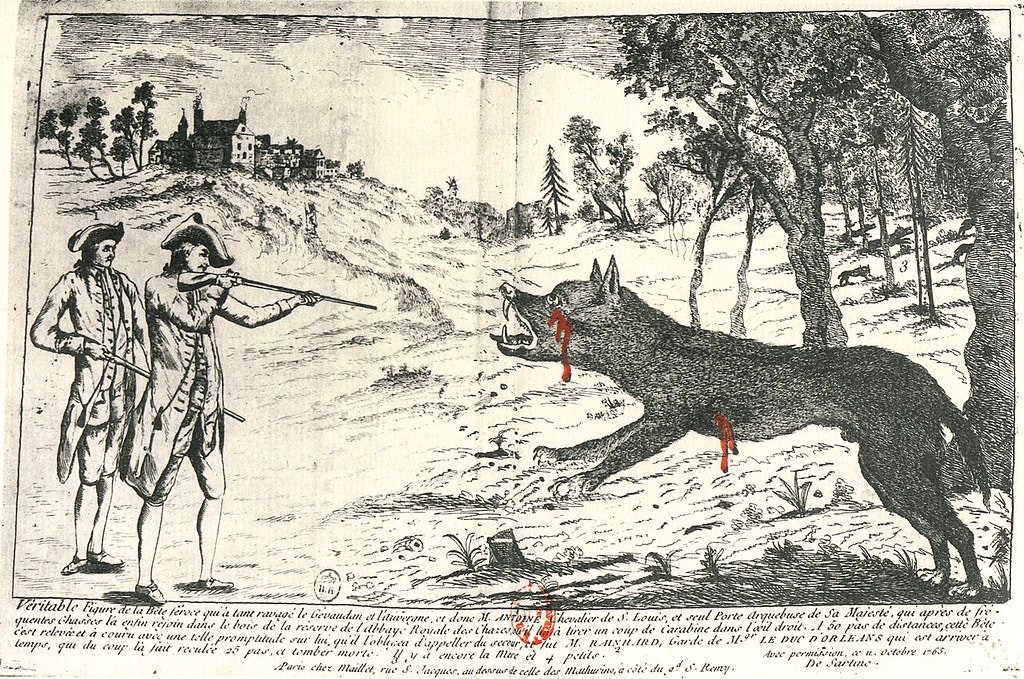
France had experienced a famous outbreak of loup -garou sightings between the years of 1764-1767, that are collectively known as the “Beast of Gevaudan.” The French Royal Court applied considerable funds and manpower to hunt down this legendary creature. 30,000 Soldiers and hunters combed the countryside in an attempt to staunch the unnatural violent occurrences. Close to 100 confirmed victims and several hundred attacks were attributed to the beast. Royal agents were able to corner and slay a monstrous wolf pair and their cub, but attacks continued. Another large wolf was also slain a year later by a local farmer as the attacks continued. Mysteriously the attacks ceased in France, but picked up across the ocean in the former colony of Quebec.
Gazette de Quebec: July 21st, 1776
We learn from Saint-Roch, near Cap Mouraska (Kamouraska) that there is a werewolf running the coast in the form of a beggar, who, with the talent to persuade what he does not know, and by promising what he cannot keep, he has to obtain what he asks for. It is said that this animal, with the help of its two hind feet, arrived in Quebec on the last 17th and that it left on the following 18th, with the intention of following its mission as far as Montreal. This beast is said to be as dangerous in its species as that which appeared last year in Gévauclan *; that is why the public is urged to beware of it like a lovely wolf.
December 11, 1767: Kamouraska, December 2. We learn that a Ware-wolfe,which has roamed through this Province for several Years, and done great Destruction in the District of Quebec [City], has caused several considerable Attacks in the month of October last. The people are armed⁹ and incensed against this Monster; and especially, the 3rd of November following, he received such a furious Blow, that it was thought the country had entirely been delivered from this fatal Animal. It soon retired to its Hole, to the great Satisfaction of the Public. But they have just learn’d, as the most surest Misfortune, that this Beast is not entirely destroyed, but begins again to show itself, more furious than ever, and makes terrible Hovock [sic] wherever he goes. – Beware then of the Wiles of this malicious Beast, and take good Care of falling into its Claws.
The beast disappeared from official public scrutiny after 1767, but the cultural imprint remains. Quebecois folklore was a syncretic variant enriched by both European Catholicism and New World Native beliefs. Natives concepts like shape-shifting and horrible syncretic creatures such as the Wendigo, lent substance to old world tales of superstition. Cultural objections to the consumption of human flesh in the form of Native American rituals, also played a large role. Whether traveling to the Americas or Africa, Europeans feared being eaten. While actual cannibalism for subsistence was very rare, widespread ritual torture and display of executed foes could be witnessed. From the Aztec to the Iroquois, captives were sacrificed and exhibited as displays of power. The same behavior can be witnessed in European practices of quartering or slow starvation of opponents in cages. The deprivation of proper burial and intimidation of other enemies was the goal. While Europeans usually treated their criminals in such manner, New World societies developed great and solemn religious ceremony for their sacrificial displays. The practice found new expression in the concept of “Scalping,” in which the participant was then paid by the overall number taken.
One last detail to take into account is the outside pressure of war, that was afflicting both France and Quebec at the time of these sightings. Might the sudden outbreak of this phenomenon be related to some sort of widespread trauma caused by conflict? Is it possible that the people of Quebec were subliminally seeking to reestablish French cultural affinity after the recent “War of Conquest?”
Interestingly enough, these tales are shared right across the wider French Atlantic World, especially in Louisiana and from the nation of Haiti. On the Island of Haiti, the “Je-rouge,” or the red-eyed werewolves stalk the population. This creature is said to be a syncretic melding of African and French beliefs. Vodou Priests are said to don animal skins and transform into vicious chimera who steal children. The Rougarou is a similar werewolf like creature, said to inhabit the environs of the great bayous of southern Louisiana. This creature is also stated to be the creation of a Voodoo spells and said to seek victims to release the curse placed upon it. Similar tales of objects placed around entrances to homes, to both confuse and prevent these creatures from entering, are told from the Caribbean to the French metropole. Just another wonderful example of the syncretic and connected nature our Atlantic world!

 Historical Caribbean Voyages